PFAS Chain Length Shapes Treatment Performance
PFAS chain length affects how far compounds travel in water and how readily treatment systems can remove or degrade them.
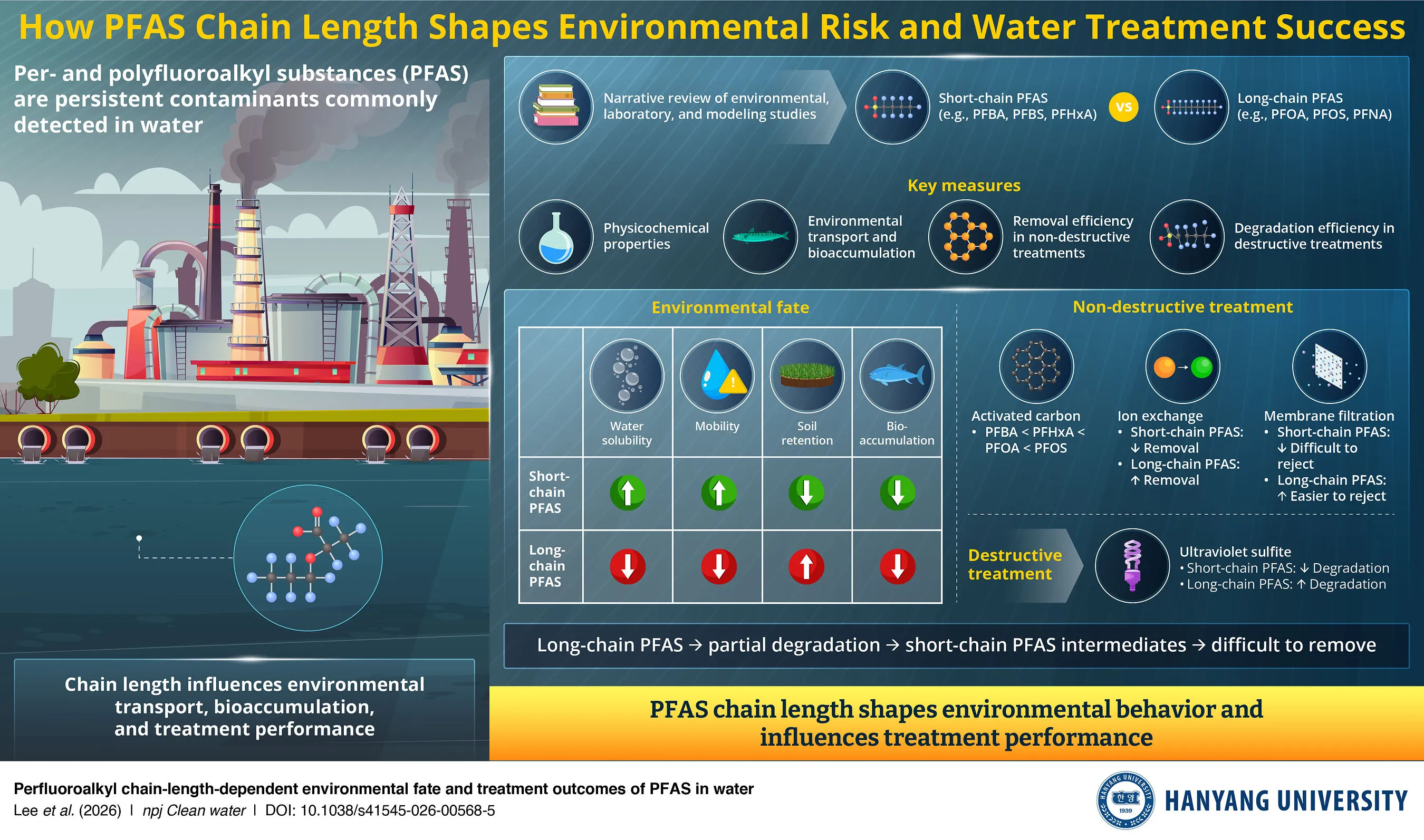
Hanyang University researchers have found that short-chain PFAS travel farther in water and are harder to remove and degrade than long-chain compounds. The review, led by Professor Eilhann E. Kwon, examined environmental, laboratory, and modeling studies of PFAS transport and treatment. Its findings were published online March 5, 2026, in Volume 9 of npj Clean Water. Understanding chain-length-dependent behavior could help utilities and remediation projects select more effective treatment approaches.
Different Movement Through Water
The review assessed physicochemical properties, environmental transport, bioaccumulation, removal in non-destructive processes, and degradation in destructive treatment systems. It covered activated carbon adsorption, ion exchange, membrane filtration, and advanced destruction methods.
Long-chain PFAS were found to bind more strongly to sediments, organic matter, and biological tissues, increasing their potential to accumulate in the environment. Those interactions also generally make long-chain compounds easier to capture with conventional treatment materials. Short-chain PFAS remain more soluble in water and can travel farther through rivers, groundwater, and drinking-water systems.
Professor Eilhann E. Kwon, Hanyang University, said:
“PFAS, often referred to as 'forever chemicals,' should not be viewed as a single uniform group. The length of the fluorinated carbon chain controls behavior of PFAS in water.”
Treatment Selection By Structure
The findings come as many short-chain PFAS are being used as replacements for older long-chain compounds. As regulations continue to evolve and new PFAS compounds emerge, treatment systems may need to move beyond one-size-fits-all approaches and become more tailored to molecular characteristics.
Chain length could support more targeted monitoring, remediation, and treatment decisions, while local conditions can still affect treatment performance.
Dr Youn-Jun Lee, first author, stated:
“Over the next 5 to 10 years, this knowledge can support more predictive and customized water treatment systems that can capture and destroy a broader range of PFAS, including the short-chain compounds.”
A Framework For PFAS Treatment
The researchers suggest that molecular structure, particularly fluorinated carbon chain length, should inform PFAS treatment strategy design.
Dr Youn-Jun Lee, first author, shared:
“Our work suggests that treatment strategies should be designed based on the molecular structure of PFAS, especially chain length.”