Pusan Study Targets Oily Seawater Desalination
Pusan National University solar desalination membrane removed over 99.99% of oil from seawater in reported tests.
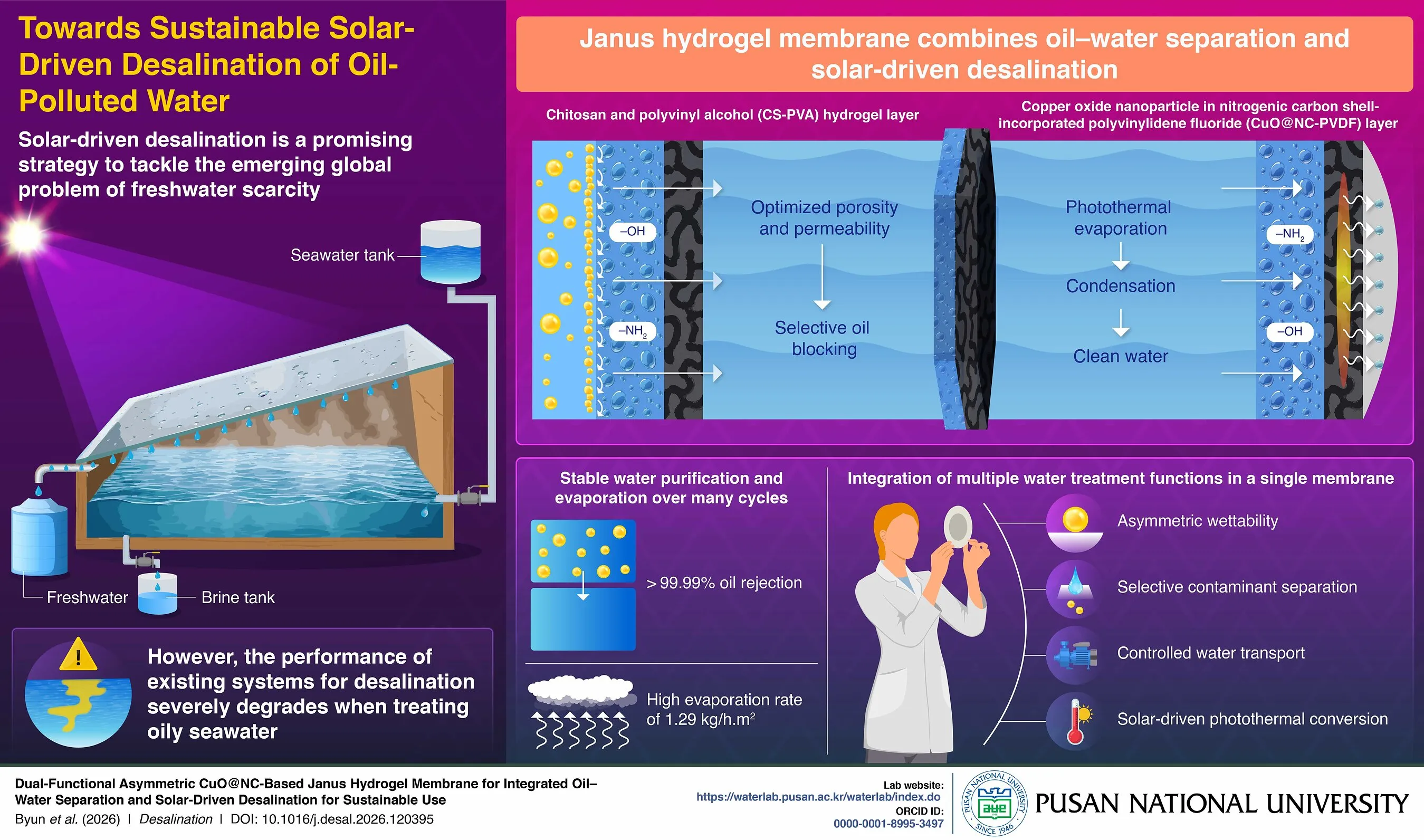
Pusan National University researchers have developed a solar desalination membrane that removed more than 99.99% of oil from contaminated seawater and produced water at an evaporation rate of 1.29 kilograms per square meter per hour. The rate is nearly three times that of a conventional single-layer membrane, according to the university. Led by Professor Sanghyun Jeong, the team combined oil-water separation and solar-driven evaporation in one two-sided hydrogel membrane. The work addresses a constraint for desalination systems operating near ports and industrial areas, where oil contamination can clog membranes.
Two Sides, Two Functions
The membrane uses a Janus architecture, with two sides designed for different functions. Its hydrophilic side, made from a chitosan and polyvinyl alcohol hydrogel, allows water to pass while repelling oil droplets. The hydrophobic side contains carbon-shell-wrapped copper oxide nanoparticles in a nanofiber layer, where absorbed sunlight is converted to heat for water evaporation.
Separating the oil-rejection and heat-generation functions is intended to avoid the interference that can occur in single-layer designs. Tests found stable performance across different oil droplet sizes and repeated use.
Solar Treatment Results
The research team reported its results in Desalination. The study was made available online June 1, 2026, and is scheduled for publication in Volume 636 on October 15, 2026.
The paper, “Dual-functional asymmetric CuO@NC-based Janus hydrogel membrane for integrated oil–water separation and solar-driven desalination for sustainable use,” assessed the design with oily seawater rather than clean saltwater alone.
Professor Sanghyun Jeong, Department of Civil and Environmental Engineering at Pusan National University, said:
“By harnessing renewable solar energy and integrating contaminant separation with freshwater production in a single membrane platform, our technology has the potential to reduce energy consumption, operational complexity, and secondary waste generation, contributing to more sustainable water treatment and freshwater production,”
Integrated Treatment Design
The study presents the membrane as a design approach for systems that must manage both contamination and freshwater production. Such multifunctional systems could help make solar-powered water treatment more practical for contaminated coastal waters and industrial wastewater, while also supporting efforts to recover useful resources from concentrated brines.
Professor Sanghyun Jeong, Department of Civil and Environmental Engineering at Pusan National University, said:
“Beyond the specific application of desalination, the broader significance of this work lies in demonstrating how multiple treatment functions can be rationally integrated within a single membrane architecture.”