Beyond the Water Tank: An Informal Water Vendor in Chattogram
Md. Muaz Hussain on a community water vendor in Aambagan Colony, Bangladesh, and what informal supply means for water safety, cost and accountability.
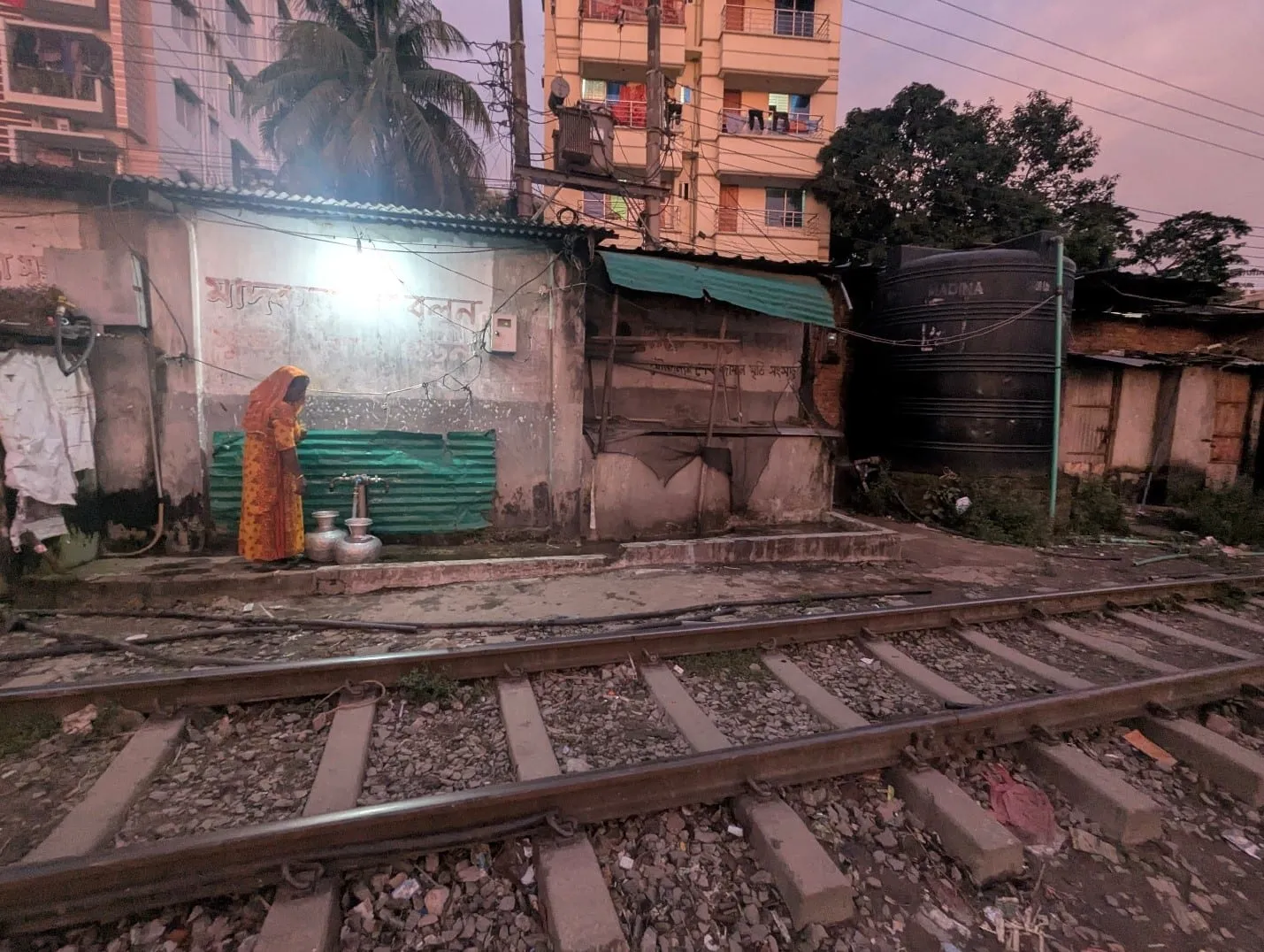
For households in underserved urban settlements, access to water may depend on arrangements that operate alongside, or outside, formal service systems. Community-based vendors and other local intermediaries can help residents navigate immediate gaps in infrastructure, but the existence of such arrangements does not by itself establish that water is safe, affordable, or reliably available (Akbar et al., 2007; Rana & Piracha, 2018, 2020). Research on Dhaka has also highlighted how informal practices and social relationships shape everyday life in low-income settlements (Hossain, 2013). These realities create a governance challenge: how can authorities learn from local arrangements without normalising inadequate services or shifting public responsibilities onto residents? This commentary considers that question through the experience of Banu Apa, a community-based water vendor in Aambagan Colony, Chattogram, Bangladesh. Based on an interview and field observations, the case describes a small-scale supply arrangement involving a storage tank, access to groundwater through landlords’ pumping infrastructure, and household purchases. Banu Apa’s reported role also appears to extend into local coordination, including helping residents navigate access to water and responding to disputes. The case does not establish how widely such responsibilities are recognised or how common they are among other vendors. Instead, it illustrates how service provision and community coordination may overlap in a particular setting. The central policy argument is that informal providers should neither be dismissed as irrelevant nor treated as substitutes for accountable public water services. Their experiences may help identify practical service gaps and local priorities, but any engagement should be tied to water-quality monitoring, source reliability, affordability, consumer protection, and clear public accountability.
How the case was gathered
This article is a policy-oriented case commentary based on a field visit and an interview with Banu Apa on 6 August 2025. She was selected as the primary participant because she was identified locally as a community water vendor who supplied water and interacted with residents. Field observations included a 500-litre water tank and water-selling activities. The article also considers an account attributed to a community member about her role in coordinating access and responding to local disputes. The available documentation does not describe the collection of that additional account in enough detail to treat it as systematic corroboration. The evidence has clear limits. No laboratory water-quality test results or formal transaction records were available. The field material does not establish the legal status of groundwater abstraction, the terms of the arrangement with landlords, seasonal changes in supply, or the affordability of water across households. The observations should therefore be read as a context-specific account rather than a representative assessment of Aambagan Colony or informal water vendors more broadly.
A supply chain that depends on others
Banu Apa reportedly operates a 500-litre water tank on a small piece of land described during fieldwork as encroached; the legal status of the land was not independently verified. The tank is connected to a tubewell, and she reportedly obtains groundwater through local landlords who own submersible pumps. According to her account, she pays the landlords BDT 500 each time the tank is refilled, with water transferred through connecting pipelines into her storage system. Residents reportedly buy water for BDT 2.50 per pitcher (kolshi). The tank may be refilled more than once on days of higher demand. This arrangement depends on several linked elements: access to pumping infrastructure, the availability of groundwater, storage, distribution, and households’ ability to pay. The vendor’s service therefore rests not only on her own work but also on continued access to infrastructure controlled by others. A disruption in that access could affect households that rely on the arrangement. However, the available evidence does not establish the legal status of groundwater abstraction or the pipeline, or the security of the agreements between the vendor and the landlords.
The costs of informal supply
According to the account shared during fieldwork, the water point operates using a storage tank with an approximate capacity of 500 litres, with each refill reportedly costing around BDT 500. Community members collect water in pitchers (kolshi), paying approximately BDT 2.50 per pitcher. The operator described the arrangement as generating a modest daily return, although detailed sales and expenditure records were not collected to verify the amount. The available information therefore does not establish the precise financial return or overall sustainability of the arrangement. These accounts nevertheless highlight the recurring costs involved in maintaining informal water provision and the reliance on small payments from community members to access water. For households with limited resources, even modest charges may represent a recurring expense, while the person coordinating water distribution must manage the costs associated with replenishing the supply. Understanding the financial sustainability and affordability of such arrangements requires more systematic information on water sales, refill frequency, operating costs, and household expenditure. This case illustrates the importance of recognising both the community-level role of informal water providers and the financial constraints under which they operate, without drawing conclusions that exceed the available evidence.
Access is not the same as safe water
No laboratory water-quality results were available for this case. It is therefore not possible to determine whether the supplied water meets drinking-water standards or is safe for consumption (World Health Organization [WHO], 2022). The source, storage, and distribution arrangements raise questions that would require testing and further documentation, rather than assumptions about contamination or safety. Community members described the cost of purchasing water as a financial burden, raising concerns about the affordability of informal water provision for residents with limited resources. However, the study did not systematically compare water expenditure or affordability across households. These gaps matter for policy. Informal provision may help residents access water when formal services are inadequate, but it does not automatically guarantee safe water, reliable supply, fair prices, or effective complaint mechanisms. Recognition of a provider should not be interpreted as certification of water quality or as evidence that the service meets public standards.
A vendor who also keeps order
The case also suggests that Banu Apa’s role may extend beyond selling water. An account attributed to a community member described her as helping residents obtain water, manage queues, and respond when property was damaged or local rules were broken. Because the process for collecting this account is not sufficiently documented, it should be treated as indicative rather than as systematic corroboration. The available evidence cannot establish that all residents recognise her as a leader, that her role is universally viewed positively, or that similar roles are common among other vendors. Even with these qualifications, the case raises a useful governance question. Where a service depends on repeated interactions among residents, vendors, and infrastructure owners, the person coordinating access may also influence everyday rules and relationships. Such work can include negotiating access, communicating expectations, and helping manage disputes. These activities may make a service provider an intermediary in local governance, although they do not confer a formal public mandate or remove the need for accountable institutions. For urban planners and service authorities, the implication is not that informal arrangements should be idealised as community resilience. Reliance on a single intermediary can create vulnerabilities, particularly when source access, pricing, and service continuity are not transparent. Community relationships are valuable sources of local knowledge, but they should be considered alongside the perspectives of different households including those who may be less connected or less able to pay and alongside the duties of formal providers.
What should change
The Aambagan Colony case points to four practical priorities. First, local authorities should create accessible channels for dialogue with residents and community-based providers. Such engagement can help identify service gaps, understand everyday access arrangements, and inform settlement-level planning. Consultation should include a range of households rather than relying on the account of a single provider. Second, engagement should be linked to appropriate safeguards. Where water is intended for drinking, testing and clear communication about water quality are essential. Authorities and relevant service providers should also consider source reliability, storage and distribution conditions, transparent pricing, and mechanisms for raising complaints. Recognition alone is not a substitute for these protections. Third, improvements to storage, distribution infrastructure, maintenance, and monitoring should complement not displace formal service provision. Informal providers may offer useful information about local needs, but public authorities retain responsibility for ensuring safe, reliable, affordable, and equitable services (Akbar et al., 2007; Rana & Piracha, 2018, 2020; WHO, 2022). Any support should avoid entrenching a system in which vulnerable households depend indefinitely on arrangements with uncertain standards or accountability. Finally, further evidence is needed before drawing broader conclusions. Follow-up work could include household interviews, documented observations of supply and refill cycles, verified transaction data, and laboratory water-quality testing. Such evidence would help distinguish the practical value of local coordination from the risks associated with unregulated or poorly documented service provision. In sum, the Aambagan Colony case illustrates how informal water provision may intersect with community coordination under conditions of institutional and infrastructural uncertainty. Its value lies not in proving that informal providers can replace formal systems, but in showing why local arrangements deserve careful attention in urban governance. Community knowledge can improve planning; it cannot replace water-quality safeguards, transparent accountability, or the public responsibility to provide safe and equitable water services.
Ethics and Consent: Verbal informed consent was obtained from the participant for the interview and the use of her information and quotations in this article.
About the author

Md. Muaz Hussain is an urban development and climate resilience professional from Bangladesh and a Fellow of the Local Pathways Fellowship at SDSN Youth. He holds a Bachelor’s degree in Urban and Regional Planning from Chittagong University of Engineering and Technology (CUET). His work focuses on water, sanitation and hygiene (WASH), locally led adaptation, climate resilience and inclusive urban governance. Find him on LinkedIn.
References
Akbar, H. M. D., Minnery, J. R., van Horen, B., & Smith, P. (2007). Community water supply for the urban poor in developing countries: The case of Dhaka, Bangladesh. Habitat International, 31(1), 24–35. https://doi.org/10.1016/j.habitatint.2006.03.001
Hossain, S. (2013). The informal practice of appropriation and social control-Experience from a bosti in Dhaka. Environment and Urbanization, 25(1), 209–224. https://doi.org/10.1177/0956247812465803
Rana, M. M. P., & Piracha, A. (2018). Supplying water to the urban poor: Processes and challenges of community-based water governance in Dhaka city. Management of Environmental Quality: An International Journal, 29(4), 608–622. https://doi.org/10.1108/MEQ-11-2017-0127
Rana, M. M. P., & Piracha, A. (2020). Supplying water to the urban poor: Government's roles and challenges of participatory water governance. Cities, 106, 102881. https://doi.org/10.1016/j.cities.2020.102881
World Health Organization. (2022). Guidelines for drinking-water quality: Fourth edition incorporating the first and second addenda. World Health Organization. https://www.who.int/publications/i/item/9789240045064.
World Health Organization. (2022). Guidelines for drinking-water quality: Fourth edition incorporating the first and second addenda. World Health Organization. https://www.who.int/publications/i/item/9789240045064